By Dt. Archana Goyal | Clinical Dietitian & Functional Nutritionist | Evidence-Based Medical Writer
For clinicians, patients, families and everyone interested in neurodiversity-affirming healthcare.
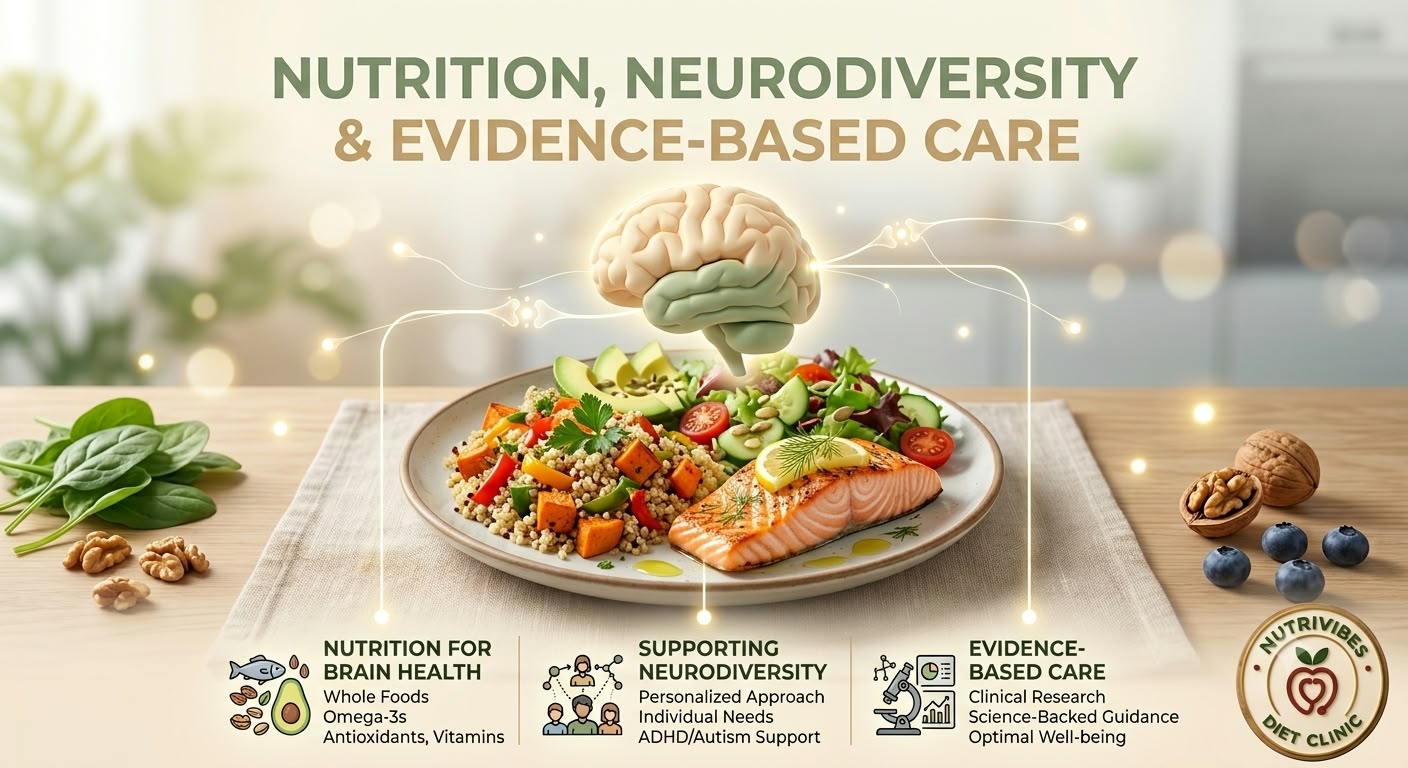
Food may not change a neurodivergent brain, but the right nutritional support can make a meaningful difference to overall health and wellbeing.
Families of children with autism or ADHD are often navigating more than a diagnosis. They may be dealing with selective eating, digestive discomfort, sleep disturbances, medication-related appetite changes and conflicting advice about what their child should or should not eat.
Amid these challenges, social media frequently promises a dietary cure, a miracle supplement or a complete gut reset.
As a clinical dietitian and medical writer, I believe we need a more responsible conversation—one that separates evidence from speculation and clinical care from commercial claims.
Nutrition is support, not a cure
Neurodivergence describes differences in how people think, learn, communicate and experience the world. Nutrition should never be framed as a way to eliminate these differences or make someone appear less neurodivergent.
The more meaningful clinical question is:
How can nutrition help a neurodivergent person meet their nutritional needs, feel physically well and participate more comfortably in everyday life?
The strongest nutrition-related evidence in this area concerns autism and ADHD, although the amount and quality of research vary considerably between topics.
What the evidence tells us
1. Selective eating deserves understanding, not blame
Food selectivity is common among autistic children. Sensory differences involving texture, smell, colour, temperature and presentation can make certain foods difficult to tolerate. Predictability and familiar routines may also influence eating.
For some individuals, restriction becomes severe enough to warrant assessment for Avoidant/Restrictive Food Intake Disorder (ARFID).
The clinical concern is not simply whether a child eats a wide variety of foods. It is whether their overall intake supports adequate growth, nutrient status and daily functioning.
A practical clinical approach: Assess the foods a child reliably accepts, identify nutritional gaps and introduce changes gradually. Pressure, punishment and forced feeding can increase distress and make mealtimes more difficult.
Feeding difficulties are not proof of poor parenting. Families need practical support, not judgement.
2. Gut health matters—but it does not explain everything
Research indicates that gastrointestinal symptoms, including constipation, abdominal pain and diarrhoea, occur more frequently in autistic children than in their neurotypical peers.
These symptoms deserve proper clinical assessment. Pain or discomfort may affect sleep, appetite, concentration and behaviour. In people who have difficulty communicating discomfort, changes in behaviour may sometimes be an important signal.
However, an association between autism and gastrointestinal symptoms does not establish that gut dysfunction causes autism.
The clinical priority is to identify and treat the gastrointestinal problem—not to assume that every behavioural difference originates in the gut.
3. Nutrient deficiencies should be assessed, not guessed
Studies have reported differences in average iron status and vitamin D levels in some children with ADHD. Findings for zinc and other nutrients are also being investigated.
These observations do not establish that a deficiency causes ADHD, nor do they mean that every child with ADHD needs supplementation.
Assessment should be guided by dietary history, symptoms, medical history, medications, growth and individual risk factors. Laboratory investigations should be clinically appropriate rather than ordered indiscriminately.
When a deficiency is identified, treatment should be individualised and monitored.
Unnecessary supplementation can cause harm, particularly when high doses of iron, vitamin A or zinc are used without appropriate supervision.
4. Overall dietary quality is important
A balanced dietary pattern that provides adequate energy, protein, fibre, essential fats, vitamins and minerals supports general health and normal physiological functioning.
Research has explored associations between ultra-processed food intake and attention, mood and other health outcomes. However, observational associations cannot establish cause and effect.
It is also important to recognise that a person with sensory sensitivities, restricted food preferences or executive-function challenges may find meal planning, shopping and food preparation difficult.
Nutrition advice must therefore be achievable, not merely ideal.
A recommendation is useful only when it respects the person's sensory needs, food preferences, culture, resources and daily routine.
What is promising but not yet conclusive?
Omega-3 fatty acids
Some meta-analyses of randomised trials have reported small improvements in ADHD symptoms with omega-3 supplementation. Results are variable, and the evidence does not support presenting omega-3 as a replacement for established ADHD treatment.
Adequate dietary intake is important, but supplementation should be considered in the context of the individual's diet, clinical needs and preferences.
The gut–brain axis and microbiome
The relationship between gut microorganisms, immune signalling, metabolism and brain function is an active area of research.
Some early studies have explored probiotics, prebiotics and microbiome-based interventions in autism. However, differences in study design, sample size, interventions and outcomes make firm conclusions difficult.
These approaches should not yet be promoted as established treatments for autism or as reliable ways to improve core autistic characteristics.
The science is evolving. Clinical recommendations must evolve with it—not run ahead of it.
Individual food sensitivities
Some people have genuine food allergies, coeliac disease or other medically relevant food intolerances. Addressing these conditions can improve health and comfort.
That is different from assuming that gluten, dairy or another food is harmful to every neurodivergent person.
Elimination diets should have a clear rationale, an appropriate review period and a plan to maintain nutritional adequacy.
What should we be cautious about?
The current evidence does not justify promising that a particular diet can cure autism or ADHD.
Nor does it support routinely prescribing gluten-free or casein-free diets to every autistic child. Systematic reviews, including Cochrane reviews, have found the evidence for consistent benefit to be limited or uncertain.
Detoxification protocols, unregulated supplements and treatments marketed around unsupported heavy-metal claims deserve particular caution. Some can be ineffective, expensive or dangerous.
When a treatment promises a cure, demands restrictive eating or profits from a family's fear, it is time to ask for credible evidence.
Translating evidence into clinical practice
For clinical dietitians, paediatricians, psychiatrists, therapists and other healthcare professionals, a practical approach begins with listening.
- Assess the whole picture: Review eating patterns, growth, gastrointestinal symptoms, sleep, medications and relevant medical history.
- Identify nutritional risk: Consider dietary adequacy, feeding difficulties and the need for appropriate clinical investigations.
- Respect sensory differences: Work with accepted foods and introduce unfamiliar foods without coercion.
- Make realistic changes: Start with one manageable step rather than an overwhelming list of restrictions.
- Coordinate care: Involve the appropriate medical, feeding and allied-health professionals when needed.
- Protect established treatment: Dietary changes should not replace prescribed medication, behavioural support, therapy or other indicated care.
Access matters, too. Specialist services may be unaffordable or unavailable for many families. Effective nutrition support should consider food budgets, local availability, cultural eating patterns and the practical realities of family life.
A nutritionally adequate meal does not need to be expensive, fashionable or complicated.
A message to my fellow healthcare professionals
Let us ask about nutrition without assuming that nutrition explains everything.
Let us screen for feeding difficulties, recognise the possibility of nutritional inadequacy, address gastrointestinal symptoms and use evidence proportionate to the strength of the research.
Most importantly, let us involve neurodivergent people in conversations and decisions about their own care.
Nothing about us without us.
The bottom line
Nutrition is not a cure for neurodivergence. It is, however, an important and modifiable part of whole-person healthcare.
Our responsibility is to provide evidence-based, individualised and compassionate support—without creating fear, promising miracles or turning normal differences into problems that must be fixed.
As a clinical dietitian, I believe the goal is not to make every person eat the same way or respond to the same intervention. It is to help each individual access the nourishment, comfort and care they need to thrive.
Because good nutrition care begins not with a list of forbidden foods, but with understanding the person sitting in front of us.
A question for healthcare professionals and families: What has helped you make nutrition more accessible and less stressful for neurodivergent individuals?
Share your experience or perspective in the comments. Respectful, evidence-informed conversations help all of us learn.
Disclaimer: This article is for educational purposes and does not replace individual medical or dietetic advice.
Selected scientific references
- Sharp WG, et al. Feeding problems and nutrient intake in children with autism spectrum disorders: a meta-analysis and comprehensive review. Journal of Autism and Developmental Disorders. 2013. Read the abstract
- McElhanon BO, et al. Gastrointestinal symptoms in autism spectrum disorder: a meta-analysis. Pediatrics. 2014. Read the summary
- Lasheras I, Real-López M, Santabárbara J. Prevalence of gastrointestinal symptoms in autism spectrum disorder: a meta-analysis. Anales de Pediatría (English Edition). 2023;99(2):102–110. Read the paper
- Iron status in ADHD: systematic review and meta-analysis of serum ferritin and iron. Read the review
- Khoshbakht Y, Bidaki R, Salehi-Abargouei A. Vitamin D status and ADHD: a systematic review and meta-analysis of observational studies. Advances in Nutrition. 2018. Read the review
- Bloch MH, Qawasmi A. Omega-3 fatty acid supplementation for the treatment of children with ADHD symptomatology: systematic review and meta-analysis. Journal of the American Academy of Child & Adolescent Psychiatry. 2011. Read the study
- Cooper RE, et al. Effect of omega-3 polyunsaturated fatty acid supplementation on emotional dysregulation, oppositional behaviour and conduct problems in ADHD: systematic review and meta-analysis. Journal of Affective Disorders. 2016;190:474–482. Read the study
- Millward C, et al. Gluten- and casein-free diets for autistic spectrum disorder. Cochrane Database of Systematic Reviews. 2019. Read the review
Note: These references are a selected starting point, not an exhaustive or fully updated systematic review.